
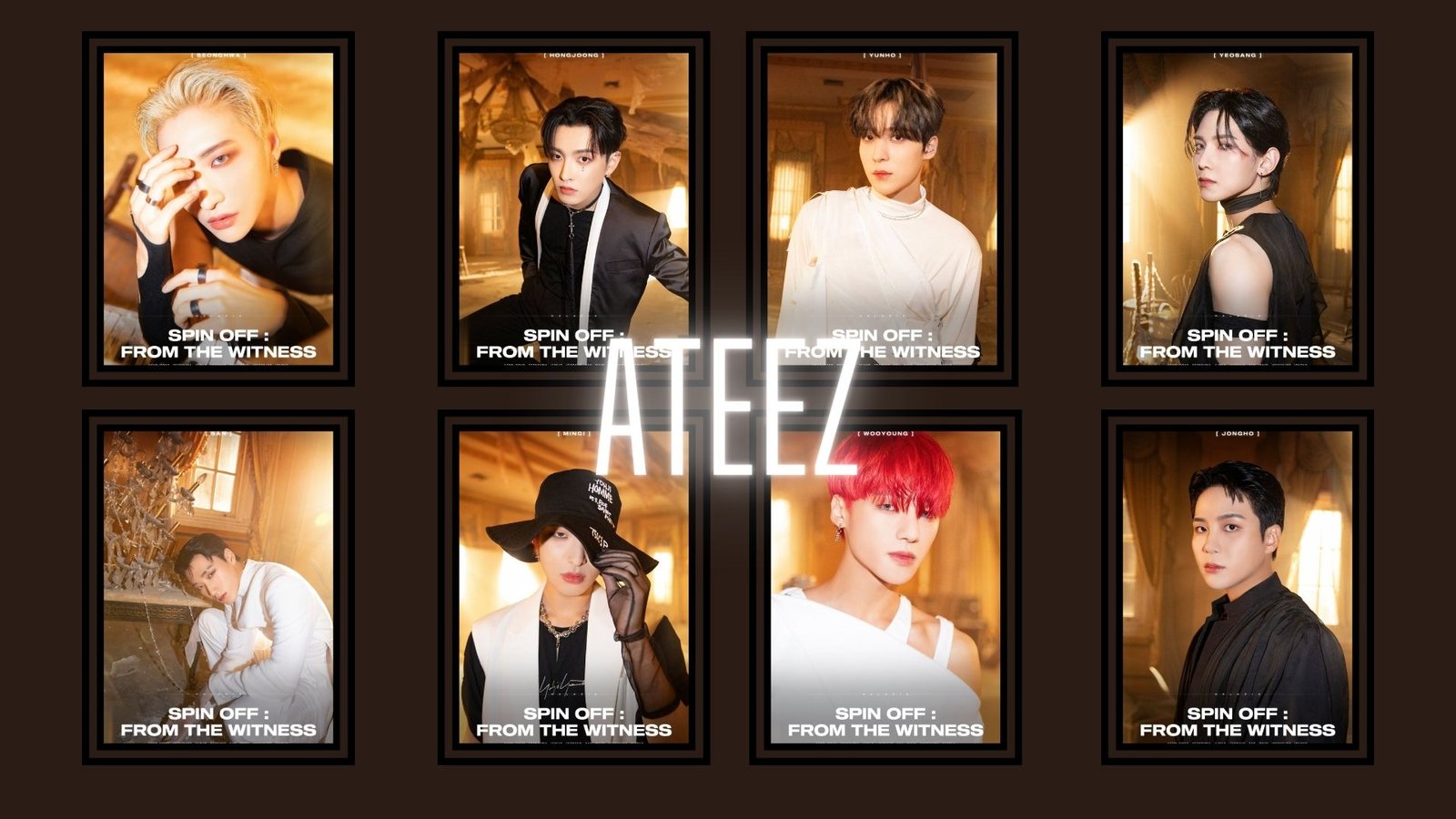
The summer of 2025 has witnessed a seismic shift in the K-pop landscape as ATEEZ, the eight-member powerhouse known for their theatrical performances and narrative-driven discography, unleashed their 12th mini-album “Golden Hour: Part 3” on June 13. This latest installment completes the group’s acclaimed trilogy exploring the fleeting, radiant moments of youth through a lens of emotional intensity and artistic maturation. Within hours of its release, the album ignited global charts, shattered personal records, and established ATEEZ as the defining act of the season. The convergence of nostalgic sonic textures, visceral lyricism, and conceptual ambition positions “Golden Hour: Part 3” not merely as a musical release but as a cultural phenomenon that redefines summer anthems in the K-pop canon.
The Culmination of a Golden Era: Album Anatomy and Thematic Evolution
The Trilogy’s Emotional Crescendo
“Golden Hour: Part 3” represents the final chapter in ATEEZ’s exploration of adolescence’s transient beauty, following 2023’s “Part.1” and 2024’s “Part.2”. Where previous installments captured the euphoria and turbulence of youth, this concluding volume delves into what leader HONGJOONG describes as “the most honest and expressive part” of their journey. The album’s five tracks—”Lemon Drop,” “Masterpiece,” “Now This House Ain’t a Home,” “Castle,” and “Bridge: The Edge of Reality”—form a narrative arc examining temptation, emotional suppression, and cathartic release. This thematic depth is amplified by member involvement, with HONGJOONG and MINGI contributing lyrics to four tracks, anchoring the project in personal authenticity. The musical alchemy balances summer-infused vitality with ATEEZ’s signature intensity, creating what main vocalist JONGHO characterizes as “that refreshing, summer breeze kind of feeling, but also something deeper”.
Physical Manifestations: Collector’s Paradise
The album’s physical releases transformed commerce into art, offering multiple immersive experiences. The POCAALBUM version featured nine distinct editions (group plus individual member variants), each containing an envelope, photo stand, stickers, QR card, image card, randomized photocards, polaroids, and digital content. U.S. retailers amplified exclusivity, with Target offering “THIRST” and “HEAT” variants containing unique photocards like the “ANGY Ver.” and “CHU Ver.” polaroids. Meanwhile, hello82’s digital release included member-specific cover art for HONGJOONG, SEONGHWA, YUNHO, and YEOSANG, catering to diverse fan preferences. These meticulously crafted editions reflect K-pop’s material culture evolution, where album design becomes an extension of artistic narrative.
“Lemon Drop”: The Sonic Embodiment of Summer
Deconstructing the Title Track
“Lemon Drop” emerges as the album’s centrifugal force—a cocktail of effervescent production and subversive lyricism. The track blends tropical house synths with infectious pop-rock guitar riffs, creating what SEONGHWA identifies as their “first proper summer song in years”[14]. Lyrically, it navigates the duality of attraction through metaphors of citrus and heat, with lines like “Bitter and sweet, a spread of luxury / You’re so bad, stop tempting me” capturing the tension between desire and restraint[15]. The composition showcases ATEEZ’s vocal versatility, from YEOSANG’s crystalline pre-chorus to SAN’s raspy ad-libs in the final bridge, all anchored by MINGI’s rhythmic rap breakdown that serves as the track’s structural pivot.
Visual Storytelling and Choreographic Innovation
The official music video, amassing 24 million views within 48 hours, translates the song’s thematic contrasts into visceral imagery. Director Lee Gi-baek employs surrealist aesthetics: members materialize in melting plastic couches, dance within kaleidoscopic projections, and interact with oversized citrus fruits under neon lighting. The choreography, showcased in a separate dance practice video, integrates liquid body waves with sharp hits, embodying the “sweet and sour” concept through movement. Particularly noteworthy is the “cassette tape” sequence, where members rewind and fast-forward their motions—a literalization of the lyric “Play it out, wind it back, turn around and pack it up again”. This synthesis of auditory and visual metaphor establishes “Lemon Drop” as a masterclass in K-pop’s multisensory storytelling.
Chart Domination and Historic Milestones
Billboard Conquest and U.S. Market Penetration
The album’s commercial impact proved historic, debuting at No. 2 on the Billboard 200 with over 100,000 equivalent album units—the highest first-week sales for any K-pop artist in 2025. Simultaneously, “Lemon Drop” entered the Billboard Hot 100 at No. 69, marking ATEEZ’s maiden entry on the flagship singles chart. This dual achievement cemented their status as only the fourth K-pop act ever to chart both a top-two album and Hot 100 single concurrently. The album dominated Billboard’s sub-charts, seizing No. 1 positions on Top Album Sales, Top Current Album Sales, and World Albums—a testament to diversified consumption across physical, digital, and streaming platforms.
Global Chart Sweep and Fandom Mobilization
Beyond the U.S., “Golden Hour: Part 3” achieved unprecedented iTunes domination, topping album charts in 20 territories including Brazil, Colombia, Finland, Indonesia, Philippines, Poland, Taiwan, and Thailand. The title track replicated this dominance, reigning atop iTunes song charts in 38 regions. This global resonance underscores ATEEZ’s strategic internationalization, facilitated by partnerships with RCA Records and hello82 that optimized stateside distribution while maintaining Hanteo chart eligibility. Notably, the album’s polaroid inclusions and randomized photocards spurred unprecedented collector engagement, with fans purchasing multiple copies to complete sets—a phenomenon driving both chart performance and cultural cachet.
Cultural Significance: Redefining K-Pop’s Summer Paradigm
Authenticity as Artistic Currency
Unlike seasonal K-pop releases prioritizing ephemeral trends, “Golden Hour: Part 3” leverages summer as a narrative device for psychological exploration. YEOSANG articulates this intention: “We wanted listeners to feel the season… but also something deeper. Through this chapter, we send a comforting message: ‘It’s okay to feel lost sometimes'”. Tracks like “Now This House Ain’t a Home” transform sun-drenched production into vehicles for existential contemplation, while “Castle” uses orchestral hits to symbolize emotional fortresses. This duality resonates with GEN-Z listeners navigating post-pandemic disillusionment, positioning ATEEZ as generational spokesmen through what critic Kim Ji-yeon dubs “euphoric melancholy”.
The Tour as Immersive Extension
The album’s cultural footprint expands through the imminent “IN YOUR FANTASY” world tour, launching July 5-6 at Incheon’s Inspire Arena before spanning 11 U.S. cities, Mexico, and Japan[6][8]. Production previews indicate unprecedented technological integration: augmented reality projections will transform venues into the album’s surreal landscapes, while setlists promise live reimaginations of “Golden Hour” tracks with extended instrumental breaks and member solos. This synergy between recorded work and concert experience exemplifies K-pop’s evolution toward transmedia storytelling, where albums function as narrative blueprints for multisensory fan immersion.
Conclusion: The Golden Hour as Eternal Dawn
ATEEZ’s “Golden Hour: Part 3” transcends seasonal novelty to establish a new paradigm for summer comebacks—one where sonic brightness and thematic depth coalesce into cultural resonance. By debuting in Billboard’s top two, breaking into the Hot 100, and dominating global charts, the album demonstrates K-pop’s continued Stateside ascendancy through artistic authenticity rather than linguistic compromise. Lyrically, it validates youth’s complexities without romanticization; sonically, it balances accessibility with innovation. As the group embarks on their stadium tour, the era promises further boundary dissolution between K-pop and global pop hegemony. For ATEEZ, this golden hour isn’t twilight—it’s dawn. With HONGJOONG’s declaration that the album delivers “coolness, catharsis, and energy that gives you a real rush,” and YEOSANG’s hope that it provides “comfort,” the project ultimately achieves pop alchemy: temporary as summer, timeless as art.